The Hostel App Your Staff Actually Needs in 2026
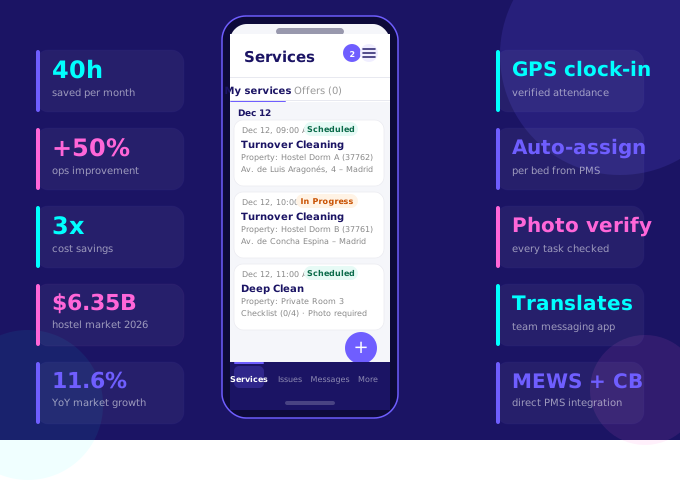
The global hostel market is projected to hit $6.35 billion in 2026 an 11.6% jump in a single year. By 2036, analysts expect that number to reach $15.5 billion, driven by the continued rise of solo travel, digital nomadism, and the growing demand for affordable urban stays.
That kind of growth sounds exciting. But for the operators actually running properties day to day, it creates a specific kind of pressure. More guests, faster turnovers, higher expectations and the same lean team trying to hold it all together.
The hostels that will grow with this market aren’t the ones with the best locations or the most Instagram-worthy common rooms. They’re the ones that have figured out how to run operations without everything depending on one manager being in the right place at the right time.
That’s where the right hostel app becomes less of a nice-to-have and more of a structural advantage.
The Industry Is Growing
Here’s the tension that rarely makes it into market reports. Demand is back, and it’s strong. But today’s hostel guest is not the same person who booked a dorm bed in 2018.
Guests arriving in 2026 expect the social energy of a great hostel and the reliability of a well-run hotel. They’ll post a one-star review over a Wi-Fi issue. They’ll rate a dorm down because one bed wasn’t properly made when they arrived. They’re price-sensitive and vocal, and the OTA algorithms amplify every negative signal.
That gap between what guests expect and what a stretched team can consistently deliver is exactly what the right hostel app is built to close.
According to research presented at the 2026 STAY WYSE Hostel Conference, staffing remains the single hardest operational challenge facing hostel managers globally. High turnover, multilingual teams, inconsistent handovers, and razor-thin margins leave almost no room for error. The cleaning staff shortage has only made this more acute over the past two years.
This isn’t a motivation problem. It’s a systems problem.
Why Generic Tools Break Down in a Hostel
Hotels manage rooms. Hostels manage beds, dorms, shared bathrooms, private rooms, and communal spaces often with guests arriving and leaving every few hours across multiple floors.
The operational complexity is genuinely different. And most software wasn’t built for it.
Task apps designed for hotel housekeeping assume room-level granularity. Property management systems track reservations, not turnovers per bed. And the informal tools most teams fall back on messaging apps, spreadsheets, verbal handovers create coordination gaps that show up directly in guest reviews.
As North American Hostels noted in their 2026 industry report, operators are being forced to professionalize roles that were once informal while still maintaining the human, social vibe that makes hostels work. A hostel needs a tool that understands this complexity from the ground up. Not one that was built for a different industry and adapted to fit.
What a Hostel App for Staff Needs to Do
The market for hospitality software is crowded. But not everything marketed as a hostel app was designed with dorm-level operations in mind. Here’s what separates the tools that actually work from the ones that just add another login.
Auto-Assign Tasks from Live Booking Data
Hostel staff scheduling should not start with a manager manually building a task list every morning. That’s not a system it’s a dependency.
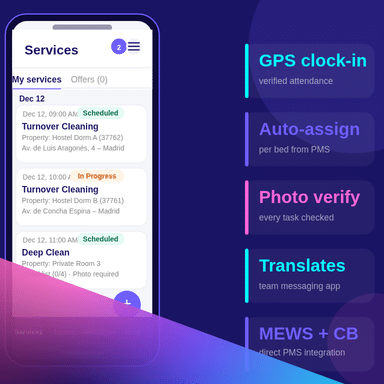
A proper hostel app connects directly to your booking system MEWS, Cloudbeds, or iCal and auto-generates cleaning tasks per bed and per dorm based on live checkout data. Same-day checkout and check-in conflicts are flagged and prioritised before they become a problem for the guest.
Good scheduling for property operations means zero manual input on a standard day and a clear fallback when things change.
GPS Clock-In and Real-Time Team Visibility
When your property spans multiple floors or buildings, knowing where your team is shouldn’t require a phone call.
GPS-verified clock-in and clock-out tells you exactly who’s on-site and when. A real-time map view shows where every staff member is at any given moment. If someone is late or absent, you know immediately and you can reassign tasks before a single guest is affected.
In hostel operations 2026, this level of visibility is no longer a premium feature. It’s the baseline for running a property that doesn’t rely on one person having eyes on everything.
Photo Verification That Can’t Be Skipped
The problem with “done” as a status is that it doesn’t mean anything unless it can be verified.
The best hostel cleaning management systems require a photo upload before any task can be marked complete. Timestamps are applied automatically and can’t be edited after the fact. This creates a clean audit trail for guest disputes, protects your team from false complaints, and gives managers real confidence in the standards being met across every shift.
Quality scores per staff member let you identify top performers, spot where training is needed, and replicate the practices that work instead of reacting to problems after they’ve already hit your Hostelworld or Booking.com ratings.
Team Messaging With Auto-Translation Built In
Hostel teams are almost always multilingual. A manager coordinating with housekeepers who speak different languages needs more than a group chat that everyone reads at different times.
A real hostel team communication app handles translation natively. Messages go out in one language and arrive in another. No switching between apps, no ambiguity, no tasks lost in translation.
Everything in one place. Everyone actually informed.
Reassignment in Seconds, Not Phone Calls
Late checkout. Sick day. A supplier running behind. Things change every day in a hostel, and your operations system needs to change with them.
Drag-and-drop task reassignment means a manager can respond to a last-minute absence in under a minute. The updated task lands on the right person’s phone. The rest of the schedule adjusts. No phone calls, no confusion, no domino effect of delays.
This is what streamlined operations actually look like in a live hostel environment not in a case study, but on a busy Saturday morning.
Cost Visibility by Dorm, Property, and Service Type
Most hostel managers have a general sense of whether they’re profitable. Fewer know exactly which dorm configuration, shift pattern, or service category is quietly eating into margin.
A complete hostel housekeeping app doesn’t stop at task management. It tracks the cost of every operation: P&L by property and dorm type, maintenance costs per ticket, invoices linked directly to specific issues. Reports you can share with owners in real time, without spending half a day pulling numbers together.
If you haven’t looked closely at your operational cost structure recently, our breakdown of P&L for hospitality businesses is a good place to start before you evaluate any new tool.
The Mid-Range Segment Is the One to Watch
One detail from the 2026 market data stands out for operators thinking about positioning: the mid-range hostel segment is projected to grow at a 12.81% CAGR through 2029 the fastest of any price tier.
This is the segment where guests expect upgraded amenities, private room options, and a noticeably more professional experience. It’s also the segment where operational consistency is the clearest differentiator.
A hostel that reliably delivers clean beds, fast turnovers, and a well-coordinated team will outperform one that offers nicer decor but inconsistent service. That’s always been true. In a growing mid-range market, it’s becoming the deciding factor for repeat guests and OTA rankings alike.
And as the WYSE Travel Confederation highlights, the hostels best positioned for 2030 are those that invest now in understanding guest behaviour, building owned brand identity, and using technology to remove friction not to replace the human experience at the centre of it.
What Doinn Does for Hostel Teams
Doinn’s hostel operations platform was built specifically for this environment. It connects directly to MEWS and Cloudbeds to auto-create tasks from live booking data. It gives managers full team visibility through GPS tracking, real-time maps, and automated payroll. And it builds quality verification into every shift mandatory photos, fixed timestamps, and per-staff performance scores.
The results operators report are consistent: more than 40 hours saved per month on operational admin, a 50%-plus improvement in daily operations efficiency, and cost savings of around 3x compared to running separate tools for scheduling, communication, and quality control.
Choosing between in-house and outsourced operations models is a separate question one we’ve explored in depth here. But whichever model you run, the operational layer underneath it needs to be solid.
One Thing Worth Remembering
The hostel industry grew because it offered something hotels couldn’t: genuine community, human connection, a different kind of travel. That hasn’t changed.
What’s changed is the expectation that those things come alongside clean rooms, reliable service, and a team that knows what it’s doing. Guests in 2026 want both. The operators who give them both consistently, are the ones building something durable.
The right hostel app doesn’t replace any of that. It protects the time and headspace your team needs to actually deliver it.
Want to see how Doinn works for your hostel team? Book a free demo and find out what 40 hours back per month looks like for your operation.