Vacation Rental Cleaning: Turnovers at Scale | Doinn
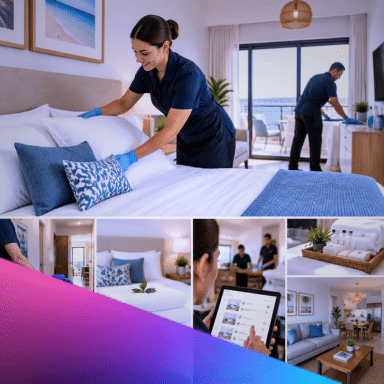
Vacation Rental Cleaning: How Property Managers Run Turnovers at Scale
Most vacation rental cleaning failures aren’t cleaning failures — they’re scheduling failures. When a manager runs 20+ units, the difference between a 5-star review and a guest complaint often comes down to whether the turnover was triggered automatically from the check-out calendar, documented with photo proof, and completed before the next guest arrives.
This cornerstone guide shows how professional property managers run same-day turnovers at scale: the checklists that survive staff turnover, the photo-proof systems that replace walk-throughs, and the cost structure that keeps margins healthy. Whether you use in-house cleaners, a cleaning company, or both, the operating system is the same.
Why turnover cleaning is a scheduling problem first
Before we talk about bleach or linen counts, let’s be clear: vacation rental cleaning breaks down because of scheduling, not scrubbing.
A typical turnover window runs from 11:00 AM check-out to 3:00 or 4:00 PM check-in — a 4 to 5-hour window. Inside that window, a team must:
- Strip beds and pull all linen
- Run a full clean of every room
- Restock consumables (toilet paper, coffee, soap)
- Reset the property (thermostat, lights, blinds)
- Inspect and document the final state
When managers rely on text messages, group chats, or spreadsheets to coordinate this, something always falls through the cracks. A cleaner shows up late. A checkout runs long. The next guest arrives to an unmade bed. One bad turnover can wipe out a week of revenue in negative reviews.
The fix: Treat turnover cleaning as a scheduling system, not a cleaning task. When the calendar drives the schedule — not a human remembering to send a text — turnovers become predictable.
The same-day turnover: what has to happen between 10 and 4
Here’s what a professional same-day turnover looks like when it’s running smoothly:
- 10:45 AM — Pre-checkout scan: The system flags which units are checking out today and which are checking in. Cleaners are pre-assigned by zone.
- 11:00 AM — Checkout confirmed: Guest leaves. Smart lock logs the departure. The cleaning task is automatically released to the assigned team.
- 11:15 AM — Team arrives: Cleaners pull linen, start the wash cycle (or stage for laundry pickup), and begin the room-by-room clean.
- 12:30 PM — Restock and reset: Consumables are replenished. Beds are made with fresh linen. Thermostat set to 70°F. Blinds open.
- 1:30 PM — Photo documentation: Cleaners upload timestamped, geotagged photos of every room through the app.
- 2:00 PM — Remote inspection: The manager reviews photos and checklist from their phone. If everything passes, the unit is marked “guest-ready.”
- 3:00 PM — Check-in instructions sent: Smart lock code activates. Welcome message goes out to the incoming guest.
None of this requires the manager to be on-site. It requires a system.
In-house cleaners, a cleaning company, or both
Most managers at 20+ units end up with a hybrid model. Here’s how the trade-offs break down:
| Factor | In-House Team | Cleaning Company | Hybrid Model |
|---|---|---|---|
| Quality control | High — direct training and oversight | Variable — depends on vendor | Best of both — supervisor + scale |
| Cost structure | Fixed (W-2 payroll, benefits) | Variable per turnover | Fixed core + variable overflow |
| Scalability | Limited — hiring takes time | High — they scale with you | High — flexible capacity |
| Admin burden | High (payroll, scheduling, HR) | Low (one invoice) | Medium |
| Best for | 10-30 units, tight quality standards | 30+ units, multi-market | 20-100 units, growth phase |
Recommendation: If you’re under 15 units, start with a reliable cleaning company. Between 15-30, hire one in-house lead and supplement with a vendor. Above 30, run a hybrid with zone supervisors and contracted overflow.
The checklist that survives a new cleaner
Your best cleaner will eventually quit, move, or take a week off. When that happens, your standard can’t leave with them. That’s why the checklist is your most valuable operational asset.
What a turnover checklist must include:
- Room-by-room tasks: Bedroom 1, Bedroom 2, Bathroom 1, Bathroom 2, Kitchen, Living Room, Patio/Balcony.
- Specific actions, not vibes: “Wipe baseboards” not “clean thoroughly.” “Replace toilet paper roll” not “restock bathroom.”
- Photo requirements: Minimum 10-15 photos per unit (bathroom mirror, toilet, kitchen counters, beds, floors, entry).
- Pass/fail criteria: Each item is checked off. Missing items trigger a re-clean before the guest arrives.
- Issue reporting: A separate field for damages, maintenance needs, or lost items.
A digital checklist in an app like Doinn makes this enforceable. A paper checklist on a clipboard makes it optional.
Photo proof and quality control without site visits
Once you pass 10 units, you can’t physically inspect every turnover. The solution is remote quality control through photo proof:
- Mandatory photo upload: The cleaner can’t mark a task complete without uploading photos of each room.
- Timestamp and geotag: Every photo is stamped with time and GPS location. No stock photos, no recycled images.
- Manager review queue: Photos land in a dashboard the manager can review from anywhere.
- Pass or re-clean: If something fails, the manager flags it in the app. The cleaner gets a notification and handles it before the check-in window closes.
This system lets one manager oversee 30-50 units a day without driving to a single property. It also creates an undeniable record when a guest claims “the place wasn’t clean.”
Linen, laundry and restocking in the same visit
The biggest hidden cost in turnover cleaning isn’t the cleaning — it’s the linen and restocking. Get this wrong and you’re making extra trips, burning margin, and risking stock-outs.
The three-jacket rule:
Every bed needs three full sets of linen in circulation: one on the bed, one in the wash, one in reserve. For a 2-bedroom unit, that’s 6 sets minimum. Drop below that and you’ll eventually have to cancel a booking because you’re out of sheets.
Laundry options:
- In-unit washer/dryer: Cheapest per turn, but adds 2-3 hours to the turnover window. Works for low-turnover properties.
- Laundry service pickup: A vendor collects dirty linen and returns clean, folded sets on a schedule. Adds $15-25 per turn but compresses the turnover window dramatically.
- On-site laundry room: For buildings with shared facilities. Requires coordination but keeps costs low.
Restocking par levels:
Set minimum stock levels for every unit (toilet paper rolls, coffee pods, soap bars, trash bags). When inventory drops below par, the system should auto-generate a restock task. Running out of toilet paper is a one-star review waiting to happen.
What automating the schedule from the PMS changes
This is where most managers leave money on the table. If your cleaning schedule isn’t automatically triggered by your PMS (Property Management System), you’re running a manual operation that doesn’t scale.
The automated flow:
- Booking confirmed in PMS: Guesty, Hostaway, Avantio, or your PMS of choice records the check-in and check-out dates.
- Integration fires: Doinn receives the reservation data via API and auto-generates a turnover task for the check-out date.
- Smart assignment: The system assigns the task to the right cleaner based on zone, availability, and workload.
- Notification sent: The cleaner gets a push notification with property details, checklist, and access instructions.
- Changes auto-sync: If the guest modifies dates or cancels, the cleaning task updates automatically. No double-booked cleans, no missed turnovers.
Managers who automate this report saving 10-15 hours per week on coordination alone. That’s time that goes back into growing the portfolio.
What a turnover should cost, and where the money goes
Pricing varies by market, but here’s a realistic breakdown for a standard 2-bedroom vacation rental in a mid-cost US market:
| Line item | Typical cost | Notes |
|---|---|---|
| Base turnover clean | $80 – $150 | Depends on size and market |
| Linen service | $15 – $35 | Per turn, if outsourced |
| Restocking consumables | $10 – $25 | TP, soap, coffee, trash bags |
| Late checkout surcharge | $25 – $50 | If guest leaves after 1 PM |
| Re-clean (quality fail) | $40 – $75 | Should be rare with good checklists |
| Deep clean (quarterly) | $200 – $400 | Carpets, ovens, baseboards |
Total per turnover: $105 – $210 for a standard 2-bedroom, depending on your model. Charge the guest a cleaning fee of $125 – $250 and you’re roughly break-even to slightly positive on the cleaning line — which is exactly where you want to be. The profit comes from the nightly rate, not the cleaning fee.
If you’re considering outsourcing entirely, browse our cleaning services marketplace to connect with vetted providers in your market.
Ready to stop firefighting turnovers?
Turnover failures are scheduling failures. Doinn connects your PMS to your cleaning team, automates assignments, and gives you photo proof of every clean — without a single site visit.
Doinn is the operations platform built for short-term rental managers who want to scale past 20 units without losing control.
- ✅ Auto-generate cleaning tasks from your PMS calendar
- ✅ Digital checklists with timestamped, geotagged photo proof
- ✅ Smart scheduling by zone, availability, and workload
- ✅ Remote quality control — approve or flag re-cleans from your phone
💡 Stop relying on group chats and hope. Build a turnover system that scales with your portfolio.
🔒 No commitment • 30 minutes • Response within 24h
Frequently Asked Questions (FAQ) about vacation rental cleaning
How long does a vacation rental turnover take?
A standard 2-bedroom vacation rental turnover takes 2 to 3.5 hours, depending on size, condition, and whether linen is laundered on-site or outsourced. Studios average 1.5-2 hours. Larger homes (3+ bedrooms) can take 4-5 hours. The key is starting immediately after checkout to hit the 3-4 PM check-in window.
How much does vacation rental cleaning cost per turnover?
Expect $105-$210 per turnover for a standard 2-bedroom in a mid-cost US market, including base clean ($80-$150), linen service ($15-$35), and restocking ($10-$25). High-cost markets like San Francisco or NYC run 30-50% higher. Most managers charge guests $125-$250 as a cleaning fee to cover this.
Should I hire a cleaning company or my own cleaners?
Under 15 units, a reliable cleaning company keeps admin low. Between 15-30 units, hire one in-house lead and supplement with a vendor. Above 30 units, most professional managers run a hybrid model with zone supervisors and contracted overflow for peak periods. The best choice depends on your quality standards and growth plans.
What is a turnover checklist?
A turnover checklist is a standardized, room-by-room list of tasks that must be completed between guests: stripping beds, cleaning bathrooms, restocking consumables, resetting the property, and uploading photo proof. Digital checklists in apps like Doinn make the standard enforceable and survive staff turnover.