5 Critical Coliving Trends You Must Prepare For in 2026

The coliving trends shaping our industry mark the end of the “wild west” era of shared living.
For years, the coliving market was defined by rapid experimentation. Operators raced to open as many beds as possible. Growth was the only metric that mattered.
But as we look toward 2026, the landscape has shifted. The industry is entering a phase of maturity.
Institutional investors are now major players. Guests are demanding hotel-quality standards. And profitability has replaced “growth at all costs” as the primary goal.
For operators, this means the rules of the game have changed. You can no longer rely on cool furniture and a community manager to fill beds. To succeed in 2026, you need operational excellence, technology that scales, and a strategy to handle a new type of resident.
This article explores the 5 critical coliving trends you must prepare for. We will look at how to adapt your operations, protect your margins, and thrive in this new era of standardized living.

1. The Institutionalization of Operations
The biggest headline for 2026 is money. Big money.
Pension funds, banks, and institutional investors have entered the chat. A few years ago, coliving was seen as a risky, niche experiment. Banks were hesitant to lend. Valuation was difficult.
That has changed completely. Reports from firms like JLL and Knight Frank show that institutional capital is now flowing freely into the sector.
Why? Because the data proves the model works. Coliving offers higher yields per square meter than traditional residential rental assets.
However, this shift brings a new level of scrutiny.
The Death of the Spreadsheet
If you are a smaller operator hoping to exit or partner with big capital, you must professionalize your back office. Institutional investors are not interested in chaos. They demand:
- Standardization: Every building must operate with the same efficiency.
- Reporting: Real-time data on occupancy, churn, and maintenance costs.
- Audit Trails: Digital proof of every dollar spent and every service delivered.
The era of managing 500 beds on Excel is over. The “flight to quality” means that inefficient operators will be bought out or pushed out. The market is consolidating, and only those with robust operational backbones will survive the merger and acquisition waves expected in 2026.
Brand Standards as a Moat
As chains grow to 5,000+ beds, maintaining a consistent brand becomes the ultimate challenge. A resident moving from your London property to your Berlin property expects the same experience.
- The WiFi speed must be the same.
- The mattress quality must be the same.
- The cleanliness level must be the same.
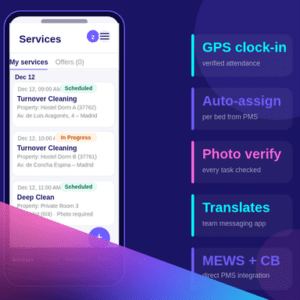
Successful operators are responding by digitizing their Standard Operating Procedures (SOPs). Instead of a paper manual that gathers dust, cleaners and maintenance staff use mobile apps to follow digital checklists. This allows a Head of Operations in headquarters to audit the quality of a building in another country without flying there.
In 2026, your brand is defined by your consistency. And your consistency is defined by your operations.
2. The “Hotelification” of the Guest Experience
The line between a hotel and a coliving space is blurring faster than ever.
Historically, coliving trends favored long-term stays (6-12 months). Hotels were for a few nights. Now, we are seeing the massive rise of the “mid-term” stay.
Remote work allows people to live anywhere for 1-3 months. These digital nomads do not want a rigid 12-month lease. But they also don’t want a sterile, lonely hotel room.
They want the community of coliving with the service standards of a hotel.
Services on Demand
This shift has birthed the concept of “Hybrid Hospitality.” Residents now expect on-demand services that were previously reserved for hotels.
- Housekeeping: The ability to book a room clean via an app.
- Linen Services: Fresh sheets and towels delivered weekly.
- Amenities: Replenishment of toiletries and essentials.
This offers a massive opportunity for ancillary revenue. However, it creates a logistical nightmare if you aren’t prepared.
Managing High Turnover
The operational challenge here is turnover volume.
A 12-month tenant only needs one deep clean and linen change per year. A 1-month tenant requires 12 times the work.
- You need to wash linens more often.
- You need to inspect rooms more frequently.
- You need to organize access for cleaning crews constantly.
If you try to manage this increased volume manually, your operations will break. You cannot rely on a single in-house cleaner who works 9-5. You need a network of professional vendors who can respond to fluctuating demand.
The operators winning in 2026 are those who view their properties as “service-first” environments. They are building infrastructure that allows a resident to live hassle-free, knowing that convenience is the ultimate retention tool.
Operational Efficiency Through Automation
In the startup phase of coliving, the focus was on top-line revenue. In 2026, the focus is on the bottom line.
Labor costs have risen significantly across Europe and North America. Staffing a property with 24/7 concierge and on-site cleaning teams is becoming prohibitively expensive. At the same time, rent caps in major cities are limiting how much you can charge.
This squeezes your margins.
The only effective response to this squeeze is extreme operational efficiency via automation.
The “API-First” Tech Stack
In 2023, operators suffered from “app fatigue.” They had one app for door access, one for community events, one for billing, and one for maintenance. None of them talked to each other.
The coliving trends for 2026 point toward integration.
Operators are cleaning up their tech stacks. They are choosing Property Management Systems (PMS) that act as a central “brain” and plugging in specialized tools via API.
A fully integrated stack looks like this:
- The PMS: Holds the reservation and guest data.
- The Access Control: Smart locks that sync with reservation dates.
- The Operations Hub: Software that reads the reservation checkout date and automatically schedules the cleaning crew.
Automating the Dirty Work
This is where specialized platforms become essential. For example, Doinn has become a vital tool for forward-thinking operators. It bridges the critical gap between your PMS and your cleaning/laundry vendors.
Instead of a property manager spending hours calling three different cleaning companies to organize turnover, software handles it automatically.
- The guest books a stay? The cleaning is scheduled.
- The guest extends their stay? The cleaning is rescheduled.
- The cleaner finishes the job? The status is updated in real-time.
By automating these logistics, you reduce the administrative burden by hours per week per property. This allows you to run with a leaner team. The operators with the leanest teams and the smartest tech stacks will have the healthiest margins in 2026.ana por propiedad. Esto permite trabajar con un equipo más reducido. Los operadores con los equipos más reducidos y las tecnologías más inteligentes obtendrán los márgenes más saludables en 2026.
4. The New Compliance: ESG and Hygiene
Environmental, Social, and Governance (ESG) criteria are no longer optional “nice-to-haves.” They are mandatory.
Investors demand ESG compliance for funding. Residents expect it for their conscience. Governments enforce it for the planet.
But in 2026, simply putting recycling bins in the kitchen is not enough. The scrutiny is deeper, and it involves data.
Los inversores exigen el cumplimiento de los criterios ESG para financiar proyectos. Los inquilinos lo esperan por su conciencia. Los gobiernos lo imponen por el bien del planeta.
Measurable Sustainability
Operators are now required to report on their carbon footprint with precision. This influences everything from construction materials to daily operations.
- Energy Monitoring: Smart thermostats that lower heat when residents leave are standard.
- Water Conservation: Low-flow fixtures and smart leak detectors are essential.
- Sustainable Operations: Investors want to see that you are using eco-friendly cleaning products and reducing linen waste.
We are even seeing the rise of “Green Leases,” where residents commit to certain energy-saving behaviors in exchange for lower utility bills. Apps are gamifying energy usage, showing residents how their apartment’s consumption compares to the building average.
Hygiene as a Legal Standard
Alongside sustainability comes the permanent shift in hygiene standards. Post-pandemic, cleanliness is scrutinized heavily.
Operators must keep logs of deep cleaning schedules. Ventilation systems must meet new air quality standards. In many regions, this is becoming a licensing requirement.
This is another reason why manual operations fail. You need a digital log that proves to an inspector that Room 204 was sanitized on Tuesday at 11:00 AM.
Using a platform like Doinn provides this digital paper trail automatically. Every cleaning job is tracked, time-stamped, and recorded. It turns operations into a compliance asset rather than a liability.
5. Demographic Diversification & Community Design
For a long time, coliving was synonymous with “recent graduates” or “students.”
That demographic is still there. But it is not the growth engine of 2026. The market has widened significantly, and your properties need to adapt to these new faces.
The New Residents
The fastest-growing demographics in coliving are:
- The 30-Something Professional: They have money, but they are lonely. They want high-end finishes, private bathrooms, and quiet coworking spaces. They do not want beer pong in the hallway.
- The Silver Splitters: Older adults (50+) who are divorced or widowed. They seek companionship and convenience without the burden of homeownership.
- Single-Parent Families: A niche but growing sector where parents share childcare duties and resources.
Designing for Diversity
This shift changes physical design. The “dorm style” rooms with shared bathrooms are losing popularity. In 2026, the standard unit is a micro-studio with a private ensuite and kitchenette. The “co” part happens in high-quality lounges, gyms, and chef’s kitchens.
But more importantly, this impacts operations.
An older demographic has higher standards for cleanliness and silence. They are quicker to complain about a dirty common area or a broken elevator.
- Maintenance: Response times must be faster.
- Cleanliness: Common areas must be spotless at all times.
- Community: Events must evolve. Wine tastings and networking nights replace pizza parties.
The Role of the Community Manager
Because of this diversification, the role of the Community Manager is evolving.
They are no longer “fixers” who unclog toilets or let in the cleaners. Technology handles that. They are now “facilitators.” Their sole job is to curate the social experience.
By automating the operational grit (Trend #3), you free up your staff to do what humans do best: empathy and connection. This is the ultimate goal of the tech stack. You don’t use tech to remove humans; you use tech to remove the robot work from humans, so they can be more human.rlos. La mejor manera de conservar a un inquilino es ofrecerle una vida sin complicaciones. Si su ropa de cama está impecable, su habitación limpia y sus solicitudes de mantenimiento se resuelven al instante, renovará su contrato. La excelencia operativa es tu mejor estrategia de marketing.
Action Plan: Preparing for 2026
The coliving trends outlined above are not hypothetical. They are happening now. The operators who ignore them risk obsolescence.
So, how do you prepare your portfolio? Here is a checklist for the modern operator.
1. Audit Your Workflow
Look at your current operations. How many hours a week does your team spend coordinating cleaning, laundry, and maintenance? If the answer is “more than 2,” you have a scalability problem. Identify the bottlenecks. Is it key exchanges? Is it inspecting rooms? Is it finding laundry vendors?
2. Upgrade Your Tech Stack
Look for the “API-first” label. Ensure your PMS can talk to your operations software. Stop using disjointed apps that create data silos. If you are struggling with turnover management, look at solutions designed for this exact problem.
3. Define Your Standards
Write down your standards. What exactly does “clean” mean?
- Does it mean the floor is swept?
- Or does it mean the baseboards are wiped and the remote control is sanitized?
Create a digital checklist. Do not leave this to chance.
4. Focus on Retention via Service
Remember that in 2026, retention is cheaper than acquisition.
The best way to keep a resident is to give them a hassle-free life. If their linen is crisp, their room is clean, and their maintenance tickets are solved instantly, they will renew. Operational excellence is your best marketing strategy.
Conclusion
The coliving industry is growing up.
The days of amateur operations are behind us. The future belongs to operators who can blend community with efficiency. It belongs to those who embrace institutional standards without losing their soul.
This transition requires a mindset shift. You are not just a landlord. You are a hospitality provider. You are selling time, convenience, and belonging.
To deliver that at scale, you must automate the mundane. You must leverage technology to handle the cleaning, the linens, and the logistics.
By doing so, you build a business that is not only profitable and scalable but also a joy to live in. And ultimately, that is what coliving is all about.