How AI Booking is Transforming Vacation Rental in 2026

You’ve probably noticed something odd in your booking patterns lately. Direct bookings from your website might be flat or declining. OTA commissions keep eating into margins. And guests seem to be making decisions faster than ever, often bypassing your carefully crafted listings entirely.
Here’s what’s actually happening: your next guest isn’t browsing Airbnb right now. They’re asking ChatGPT where to stay in Porto. And if your properties aren’t in ChatGPT’s answer, you’ve already lost the booking.
For property managers properties across Europe and the UK, this isn’t some distant future. It’s February 2026, and AI booking is already redirecting millions of guests away from traditional search. The question isn’t whether this affects you it’s whether you’ll adapt in time.
The AI Booking Revolution: What’s Really Happening
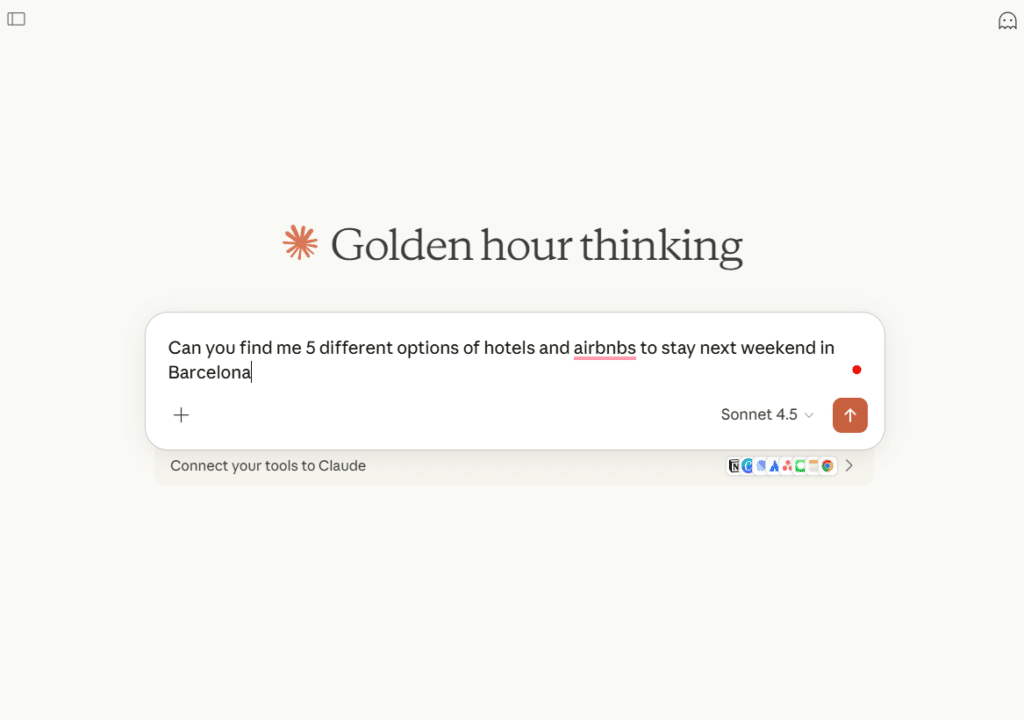
Let me paint you a picture. It’s 11 PM on a Tuesday. A couple in London decides they want a last-minute weekend in Barcelona. But instead of opening Booking.com, the wife says to her phone: “Find us a two-bedroom apartment near Sagrada Familia, under €200 per night, with good reviews and a balcony.”
Her AI assistant instantly scans hundreds of properties, checks live availability for that specific weekend, filters by her stated preferences, and presents three options complete with booking links. The entire search takes 30 seconds. She books without ever seeing your carefully optimized Airbnb listing or your direct booking website.
Have in mind this is how the process looks know, do you imagine how it´s going to be when ChatGPT ads are enable globally?
This isn’t speculation. According to recent industry data from IDC Research, AI agents are already mediating millions of travel decisions. And the numbers are accelerating fast.
Here’s what should worry you: 39% of travelers are already using AI somewhere in their booking journey. But more importantly, 15% are using ChatGPT and similar platforms specifically to find accommodations. That’s roughly one in six potential guests who might never see your traditional listings.
If you manage 20 properties and typically get 30 inquiries per property per month, that’s potentially 90 bookings per month 3-4 properties worth of revenue that could be going elsewhere simply because AI can’t find you.
Why Property Managers Can’t Afford to Ignore This
You’re already stretched thin. Between managing cleaners across multiple properties, handling maintenance emergencies, answering the same guest questions repeatedly, and trying to optimize pricing on three different OTAs, who has time to worry about “AI visibility”?
But here’s the thing: AI booking isn’t adding more work. It’s shifting where your guests come from. And if you don’t adapt, you’ll simply get fewer bookings while your competitors who do adapt capture more market share.
Think about it this way. Remember when mobile bookings started taking off years ago? The property managers who optimized their mobile experience early got a disproportionate share of bookings. Those who waited lost ground they never recovered.
AI booking is that shift but faster and bigger.
Your Competitors Are Already Moving
According to Hostaway’s 2026 Short-Term Rental Report, over 60% of short-term rental operators adopted AI tools in 2025. Among companies managing 50+ properties likely your direct competitors the number is even higher.
What are they doing with AI? The biggest wins are coming from guest communication. Automated responses to common questions. Instant booking confirmations at 2 AM. Check-in instructions sent automatically. FAQ handling without staff involvement.
One property manager we spoke with calculated that AI guest messaging saved them 15 hours per week. That’s nearly two full working days reclaimed. For a 25-property portfolio, that time savings pays for the technology ten times over.
Guests Actually Trust AI Recommendations
Here’s a stat that should change how you think about distribution: 94% of travelers trust AI recommendations as much as traditional search engines. And 25% trust AI more than OTAs like Booking.com because they believe AI is less biased toward commission-paying listings.
Even more important: 84% of travelers say that receiving a recommendation from AI makes them significantly more likely to book. Not just consider actually book.
What this means practically: if your properties show up when someone asks ChatGPT “Where should I stay in Lisbon with my family,” you’re not just getting visibility. You’re getting pre-qualified, high-intent traffic that’s ready to convert.
What Makes Properties AI-Readable?
The properties that win in an AI booking environment share specific characteristics. They’ve made themselves “machine legible” ensuring their data is structured, accurate, and accessible to AI agents.
Clean, Consistent Property Information
Here’s a simple test. Go to ChatGPT right now and search for “vacation rentals in [your city].” Do your properties appear? If they do, is the information accurate? Is it complete?
If the answer is no, you have a data problem. AI agents pull information from wherever they can find it your website, OTA listings, review sites, social media. If that information is inconsistent, outdated, or incomplete, AI either shows wrong details or doesn’t show you at all.
The fix isn’t complicated, but it does require discipline. You need one authoritative source for each property’s information. Accurate amenity lists. Current photos. Precise location data. Clear policies. Then you need that same information everywhere your website, your channel listings, your Google Business Profile.
Property managers like Omar do Rio in Brazil (managing 500+ properties) or Innkeeper Property Management in Portugal (268 properties) didn’t get to that scale with messy data. At 15+ properties, inconsistent information becomes impossible to manage manually. You need systems that keep everything synchronized.
Live Availability (Not Yesterday’s Calendar)
Imagine this scenario: A guest asks AI for “available apartments in Madrid this weekend.” Your property is actually available, but your calendar hasn’t synced in 12 hours. The AI sees it as booked and recommends your competitor instead. You just lost a booking to a technical delay.
AI booking requires real-time data. Not “updated twice daily.” Not “syncs overnight.” Actual real-time. When someone makes a booking inquiry at 10 AM on Saturday, AI needs to see your current availability at 10 AM on Saturday.
This is where your channel manager and PMS integration becomes critical. The platforms that can push live availability directly to AI systems through technologies like Model Context Protocol will capture bookings others miss.
Rich, Comprehensive Content
AI agents need context to make recommendations. Properties with detailed descriptions, accurate amenity lists, neighborhood information, and guest policies perform better in AI-driven searches.
High-quality images remain crucial. Visual content helps AI systems understand and categorize properties accurately. Professional photography isn’t just about appealing to human guests anymore—it’s about helping AI agents properly represent your properties.
The 2026 Timeline: A Critical Window
Industry forecasts from sources including Mews warn that 2026 represents a narrow window for operators to prepare systems, data, and teams for the rapid shift toward conversational search and autonomous AI booking agents.
Properties still optimizing for a world that’s disappearing polishing traditional booking engines while guests talk to AI agents risk being left behind. The operators who succeed will be the most adaptive, the most data-cohesive, and the most prepared for AI-driven distribution.
Analysts predict that half of all search engine activity could shift to AI-driven platforms by the end of 2026. This isn’t a gradual transition—it’s an accelerating one.
What You Should Do This Month
Enough theory. Let’s talk about what you can actually do in the next 30 days to prepare for AI booking. You don’t need to overhaul your entire operation. You need to take three specific steps.
Week 1: Test Your AI Visibility
Open ChatGPT, Google Gemini, and Perplexity. Search for vacation rentals in your city. Note which properties appear and what information shows up.
Then search specifically for your property name. Does it appear? Is the information accurate? Are photos current? Is pricing shown?
Make a spreadsheet with three columns: What AI got right, what AI got wrong, what AI missed completely. This is your roadmap.
Week 2: Fix Your Foundation
Pick your three most profitable properties. Create one master document for each with every detail: exact address, amenities, policies, wifi network name, parking instructions, everything.
Then update that information everywhere. Your website. Your Airbnb listing. Your Booking.com profile. Your Google Business listing. Everywhere. Make sure it’s identical.
Yes, it’s tedious. But this consistency is what makes you AI-readable.
Week 3-4: Talk to Your Technology Partners
Email your PMS provider, your channel manager, and your booking engine. Ask three questions:
1. Can you push my property data to AI platforms like ChatGPT?2. How often does availability sync?3. What’s your roadmap for AI integration?
If they can’t answer these questions or don’t have plans, start researching alternatives. Companies managing 30+ properties can’t afford to be locked into technology that ignores where the market is heading.
Operational Efficiency Through AI Booking Tools
Beyond guest-facing AI booking capabilities, property managers are leveraging AI across their operations. The technology that enables AI booking often powers broader operational improvements.
Guest communication automation stands out as a high-impact area. AI-powered messaging tools can handle routine inquiries, booking confirmations, check-in instructions, and service requests freeing staff to focus on complex issues and guest experience.
For operators managing properties across multiple markets and time zones, 24/7 automated response capabilities become crucial. Brazilian operators like HomeRio managing over 200 properties or Portuguese companies like Innkeeper Property Management with 268 listings rely on systems that can communicate with guests around the clock.
Dynamic pricing represents another area where AI delivers value. Systems that adjust rates in real-time based on demand, competitor pricing, local events, and seasonal patterns help maximize revenue while maintaining occupancy. These same data feeds that power dynamic pricing become essential for AI booking platforms.
Workflow coordination tools that use AI to optimize cleaning schedules, maintenance routing, and supply chain management create operational leverage. Companies providing these capabilities whether established players or innovative solutions like doinn that help coordinate property operations become increasingly strategic as portfolios scale.
Market-Specific Considerations for European Operators
Vacation rental operators across Europe face unique market dynamics that influence AI booking adoption. Regional regulations, language requirements, and traveler preferences vary significantly between Barcelona and Berlin, Lisbon and London.
Multi-language support becomes critical. AI agents need to understand and respond to queries in multiple languages while maintaining accuracy about property details, local regulations, and cultural nuances. Properties that can provide rich, accurate content in English, Spanish, Portuguese, French, German, and other relevant languages position themselves better.
Regulatory compliance data must be AI-accessible. As cities implement varying short-term rental regulations, AI agents increasingly factor compliance into recommendations. Properties with clear licensing information, accurate maximum occupancy data, and transparent local tax handling gain trust.
Seasonal demand patterns across European markets require sophisticated inventory management. AI booking systems that understand regional holiday calendars, school break schedules, and festival periods can optimize availability and pricing recommendations more effectively.
The Competitive Landscape Is Intensifying
As AI booking adoption accelerates, competitive dynamics shift. The gap between operators who embrace these technologies and those who delay widens quickly.
Industry analysis describes a “K-shaped” market emerging, where the strongest operators pull further ahead while others fall behind. Technology access and AI integration disproportionately benefit operators who already have strong foundations.
Being average becomes riskier than ever not because demand disappears, but because competition becomes more precise. Properties that appear first in AI recommendations, that can complete bookings fastest, and that provide the most accurate information capture disproportionate market share.
This creates urgency for mid-sized operators. Companies managing 15-50 properties face particular pressure. They’re large enough that manual processes become unwieldy but often lack the resources of 200+ property portfolios. Strategic technology choices become make-or-break decisions.
Looking Forward: What’s Next for AI Booking
The trajectory of AI booking technology points toward increasingly autonomous systems. Current platforms that recommend properties will evolve to handle complete travel planning coordinating accommodations, transportation, activities, and dining within single conversations.
Predictions from industry leaders suggest that by 2035, most hotel and vacation rental discovery will happen through single AI conversations. Rather than visiting multiple websites and comparing options manually, travelers will delegate entire trip planning to AI agents that know their preferences, budget constraints, and travel patterns.
What remains constant is the importance of exceptional guest experiences. AI will handle more of the transaction and logistics, but the properties that win long-term will still be those that deliver memorable stays. Technology amplifies operational excellence it doesn’t replace it.
The human element of hospitality becomes even more valuable in an AI-mediated world. When routine interactions get automated, the personal touches that create emotional connections stand out more. Properties that combine AI efficiency with human warmth will differentiate themselves.
Conclusion
Here’s what you need to know: AI booking isn’t replacing everything overnight. Your Airbnb listings still work. Your direct booking website still converts. Your email marketing still generates returns.
But the mix is shifting. Every month, a larger percentage of your potential guests start their search by asking AI instead of Google. If you’re not visible in those AI results, you’re losing bookings to competitors who are.
The good news? You don’t need to be a tech expert to prepare. You need clean data, consistent information across platforms, and the right technology partners. Companies managing 15-50 properties are in the sweet spot large enough to benefit from automation, small enough to implement changes quickly.
Start with the test we mentioned earlier. Open ChatGPT this afternoon and search for rentals in your market. See what appears. That 10-minute exercise will tell you more about your AI readiness than any consultant report.
Then fix what’s broken. Update your listings. Synchronize your data. Talk to your technology vendors about their AI integration plans. These aren’t huge projects they’re incremental improvements that compound over time.
Your competitors are already moving. The operators who capture market share in 2026 won’t be the ones with the biggest portfolios or the flashiest websites. They’ll be the ones who made themselves visible to AI early, while there was still room to gain advantage.
The window is open right now. But it won’t stay open forever.